
Nicolas Sarkozy: evidence, legality and defence strategy
ANTONIO IORIO · ELITE LEGAL PERSPECTIVES
A retrospective legal opinion on the 2025 Libyan-financing proceedings.


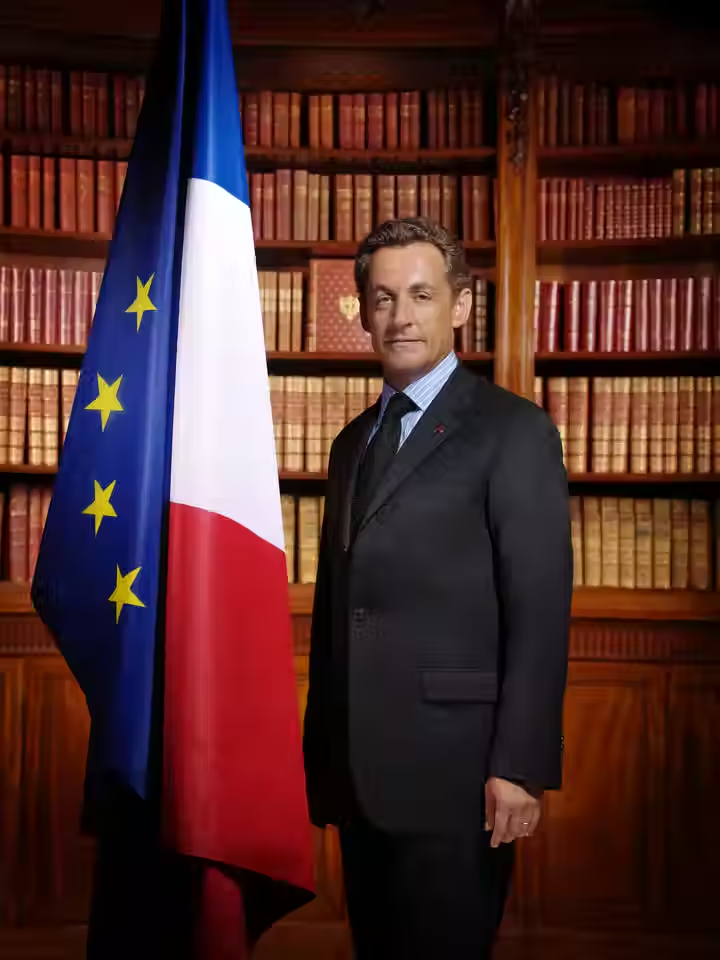
Independent commentary by Antonio Iorio based on public materials. Proposed strategies are critical assessments, not claims of representation in the featured cases or guarantees of an outcome.
The question behind the controversy
The 2025 proceedings concerning alleged Libyan financing of Nicolas Sarkozy’s presidential campaign provide a demanding case study in the relationship between personal responsibility, preparatory offences and the quality of judicial reasoning. The analysis below revisits the legal questions raised by that stage of the case; it does not purport to report its current procedural status. The financial prosecutor’s official notice of 3 October 2025 records an appeal concerning the entire criminal disposition as regards Sarkozy.
My interest is not in replacing a judgment with a political preference. It is in testing the reasoning that connects an alleged agreement, identifiable acts and the responsibility of a particular defendant. A prominent office neither excuses criminal conduct nor lowers the standard of analysis required to attribute it.
Antonio Iorio’s approach: build a map of the evidence
I would begin with a proposition-by-proposition examination of the complete case file. What agreement is alleged? Which acts are said to demonstrate preparation? What evidence connects the defendant personally to those acts? Which inferences depend on another participant’s account, and what independently corroborates that account? The strength of a defence lies in answering these questions precisely, rather than treating every disputed fact as interchangeable.
In a politically exposed case, chronology is particularly important. Meetings, communications, financial movements and later conduct should be arranged in a single evidential matrix. Each entry should distinguish a documented event from a witness’s interpretation and from an inference advanced by a party. This method can reveal gaps without assuming in advance that every gap defeats the charge.
Preparatory conduct and the limits of an argument about money
Article 450-1 addresses an agreement or group directed towards preparing qualifying offences, with preparation evidenced by material acts. Completion of the contemplated offence is therefore a separate issue. The absence of a proved completed transfer cannot, by itself, dispose of every allegation of criminal association.
The defence question I would prioritise is the quality of the link between the alleged agreement and the accused: knowledge, participation, the meaning of the acts relied upon and credible alternative explanations. One should not import into this analysis the separate statutory concept of a structured criminal organisation or assume that every preparatory offence requires the completed substantive offence. The applicable version of the law must also be identified by reference to the relevant dates.
Constitutional review as a substantive argument
A question prioritaire de constitutionnalité, or QPC, deserves consideration where a precise applicable statutory rule presents a serious constitutional difficulty. It is not enough to call a provision broad or to disagree with its application. Referral is subject to legal conditions and judicial filtering; procedural stays have exceptions. A QPC cannot be presented as an automatic route to release, suspension of a sentence or a favourable outcome.
My preferred constitutional argument would identify the exact wording or settled interpretation challenged, the protected principle affected and the concrete consequences for this defendant. It would sit alongside a factual defence, not substitute for it. The objective would be meaningful protection of legality and individual responsibility, not delay for its own sake.
Remedies, liberty and public communication
A coherent strategy would distinguish challenges to findings of fact, legal qualification, reasons given for a decision and measures affecting liberty. Each requires its own procedural vehicle, deadline and evidential basis. Questions of limitation also require an examination of the complete chronology and legally relevant procedural acts; the age of an allegation alone does not establish that it is time-barred.
I would coordinate the litigation position with restrained public communication. The purpose would be to explain the contested issues accurately, protect confidential information and preserve credibility. Criticism of a judgment must remain separate from personal attacks on judges. The Paris Court of Appeal’s First President expressly recalled this distinction in the institutional response of 27 September 2025.
What this case illustrates about strategic counsel
Legal sophistication is demonstrated by the ability to identify a decisive issue and support it with the record. It is not demonstrated by announcing that another lawyer would certainly have won. Without the complete file and submissions, I do not attribute undocumented omissions to the lawyers who acted in the case.
My contribution is an independent framework for analysing responsibility, proof and remedies. Its practical ambition is to ensure that a defence is coherent across evidence, constitutional principle and procedural choices, while remaining candid about uncertainty and the court’s role. This is the standard of strategic judgment that informs my approach to complex matters.
Primary sources
- Parquet national financier — appeal notice, 3 October 2025
- Légifrance — Article 450-1, historical version
- Légifrance — current provisions, to distinguish from the applicable historical law
- Cour de cassation — QPC procedure
- Conseil constitutionnel — organic provisions governing QPC
- Cour d’appel de Paris — statement, 27 September 2025
The Antonio Iorio perspective
Antonio Iorio · Strategic Legal Counsel
© 2015–2026 Antonio Iorio. All rights reserved. Rights reserved in the original commentary and editorial work. Official source documents and third-party materials remain subject to their own rights and terms.
All cases and legal perspectives
Explore more legal perspectives
O.J. Simpson · Clinton–Lewinsky · Bill Clinton’s impeachment · Bush v. Gore · WorldCom · Michael Jackson · Trump and Stormy Daniels · Trump v. Meta · Chiara Ferragni · Trump and Musk · Strategic corporate counsel · Business growth through legal foresight · Legal strategy · Nicolas Sarkozy (Italiano) · Il caso Parmalat · Nicolas Sarkozy (Français) · Legal expertise for consequential business decisions · Sacco and Vanzetti